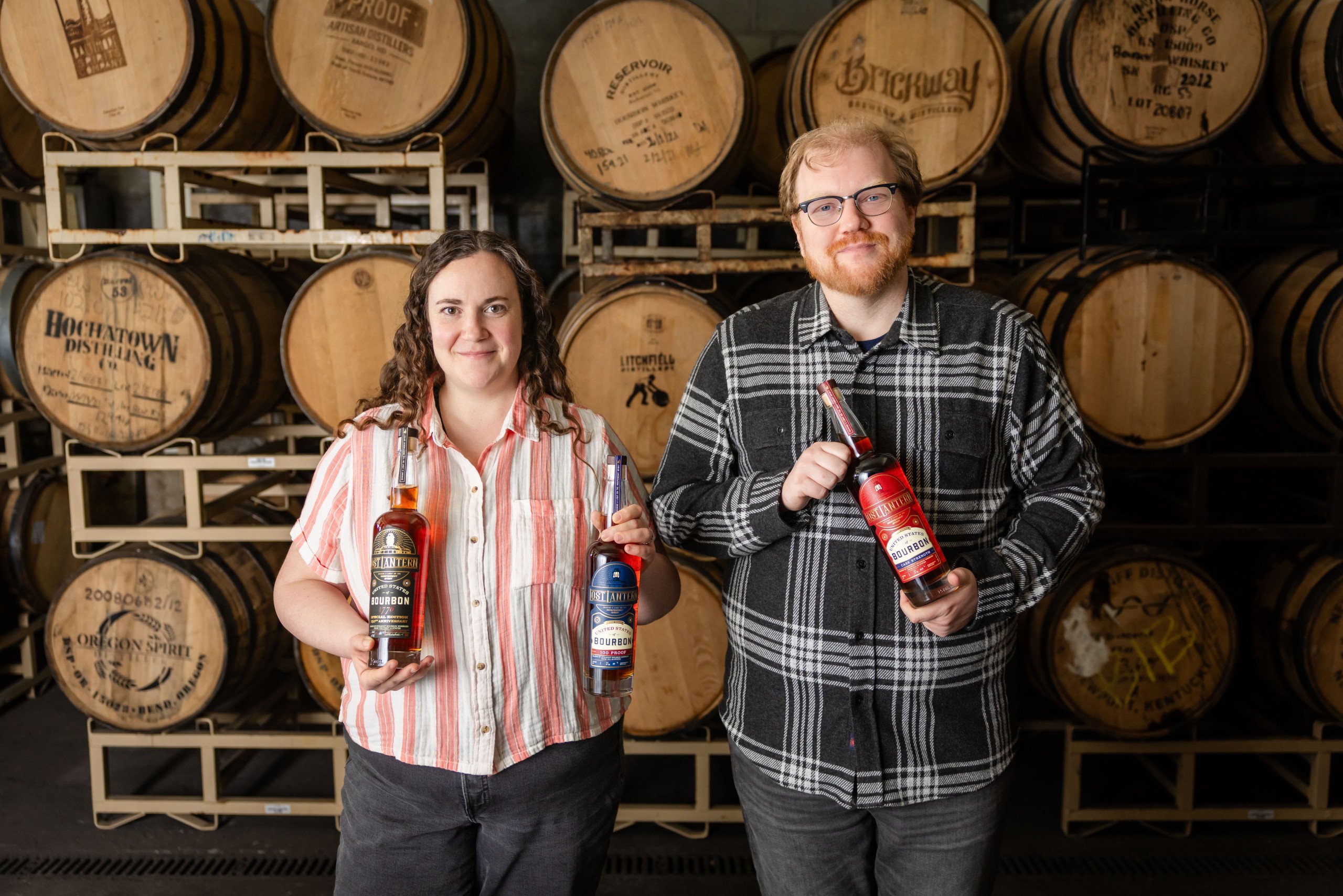
Lost Lantern Ask Me Anything: United States of Bourbon FAQ’s and Fun Facts
A few weeks ago, we asked our newsletter crew what burning questions they had about Lost Lantern and the United States of Bourbon behind the scenes, and they delivered! Below are answers to some questions we haven’t addressed. Nora will answer a few more on social media next week; if you don’t already, follow us there!
And now, without further ado, the results of our Ask Me Anything!
Q: What were the hardest states to get?
A: Idaho (until Day’s Defile announced out of nowhere), Oklahoma, Utah, and (for logistical reasons) Hawai’i and Alaska. All of them were hard for different reasons. For Oklahoma, it was because Hochatown has a lot of local demand for their whiskey and it was tough for them to spare a barrel. For Utah, we knew we wanted to work with High West–but they’re part of a bigger company and had never sold whiskey to anyone before. Selecting the barrels was easy, but all the other details took some time! And of course, figuring out how to get bourbon from the middle of the Pacific to Vermont took some doing.

Q: In many of the states, you work with multiple distilleries. Were there any particularly tough choices between distilleries?
A: We did have to make some tough calls for some states where we have worked with multiple distillery partners. We decided early on that we wanted one and only one distillery from each state. The toughest call was Texas, where we have worked with four distilleries, three of which produce bourbon: Balcones (the United States of Bourbon representative for Texas), Ironroot Republic, and Still Austin. We love all three of them, and have worked with both Balcones and Ironroot from day one. So in this case it actually came down to availability: Balcones has a lot more bourbon to spare, and we had some in-house already. Ironroot is smaller and in such demand that I always feel almost guilty asking for casks.
In other states with multiple options, we tended to make similar calls: it wasn’t just whose bourbon we liked best (if we’ve worked with them, we like it!), but whose works best for blending, who would be most enthusiastic about the project, or sometimes even who we already had bourbon from in-house.
Q: Any fun new or old distilleries to highlight in the United States of Bourbon?
A: Yes! The release includes over a dozen new Lost Lantern partners, including High West in Utah, Ko’olau in Hawai’i, Liberty Pole in Pennsylvania, and many more. Discovery Club members will recognize distilleries from recent releases, such as Proof in North Dakota and Painted Stave in Delaware. And the blend also features regular Lost Lantern partners, like Corbin Cash, Cedar Ridge, Starlight, Balcones, and more. It also includes bourbon from three ghost distilleries (Rich Grain in MS, Sourland Mountain in NJ, and Stonecutter in VT).
Q: Some of these distilleries release sourced whiskey. Is this their own in-state distillate?
A: Yes! Of course, and this is part of why it was so important that we visited every distillery in the blend and worked with them closely on this project. That means the High West is Utah-distilled bourbon, for example. This also applies to a few distilleries that have rarely or never before released their own bourbon distillate (Triple Eight in MA, BlackFork Farms in SD).
Q: Is it a blend of equal parts?
A: No! While no distillery predominates (the largest single component, Cedar Ridge, is only 14%, the next less than 10%), they are not equal proportions. Some have fairly small amounts, either because they were on the younger side or because we simply couldn’t get very much. Some have several full barrels. But all 50 states are in there!

Q: Landing at a 123.0 cask strength proof with barrels coming in from drastically different climates and warehouse conditions across the country is fascinating. How did you manage the proof and maturation differences across such varied regional aging styles when marrying all 50 together?
A: I (Nora) mostly didn’t! Because there are so many different inputs to a whiskey, I try to meet it where it is during blending. To explain a bit more, if a whiskey’s dominant flavor is oaky, I don’t think as much about why (e.g. age or climate) but instead I focus on how it will complement the other whiskies I’m working with (e.g. will the oak spice round out a profile that is already leaning towards a cinnamon bun). If I could, I’d prefer to blend without any knowledge of the whiskey’s details! I’d rather let the flavors and aromas lead the way.
The exception is hazmat whiskey. I have to be careful with those as they can pull the whiskey way off balance. I now know that I need to start with smaller amounts of those and slowly scale up carefully.
Q: Which distillery locations stood out as being particularly beautiful or wonderful locations?
A: We’ve seen so many beautiful distilleries around the country! Some of the standouts featured in United States of Bourbon include Leiper’s Fork in Tennessee (beautiful rolling countryside and usually live bluegrass on the porch), Cedar Ridge in Iowa, High West in Utah, Woodinville in Washington, and of course both Denali Spirits in Alaska and Ko’olau in Hawai’i – hard to beat either in terms of location, although they’re a bit of a trek!
Adam is also partial to estate distilleries, which have a beauty of their own–as long as you like cornfields. Frey Ranch, Whiskey Acres, Corbin Cash, and Far North are all estate distilleries we’ve talked a lot about before, but we’ll also put in a plug for BlackFork Farms in South Dakota. A gorgeous spot.
There are also some very cool urban distilleries, the most impressive of which is probably J. Rieger & Co. in Kansas City. Kings County Distillery in the Brooklyn Navy Yard is tough to beat too!
 Q: What is your process when it comes to selecting and featuring whiskeys? Would there ever be a brand that you would not consider working with?
A: We are quite particular about the distilleries we choose to work with and the whiskey we select–after all, there are 2,000 distilleries in the United States, so even the 50 in the United States of Bourbon are a very small portion of the total. We need to visit every distillery we will potentially work with in person so we can understand their approach, their team, why they make their whiskey the way they do, and what their vision is. This helps us find partners that align with us–not just in terms of making great whiskey, which is a given, but in making whiskey with a real vision or perspective behind it.
We also have a “no assholes” policy. We are proudly representing and talking about these distilleries and introducing them to people who have never heard of them before. And we don’t want to do that if we just don’t like the people behind the brand. Thankfully, this happens rarely! But still, there are many whiskey distilleries that we wouldn’t work with for a variety of reasons, even if we respect what they do, if it just doesn’t align with our perspective or our palates.

Q: You said United States of Bourbon: 1776 Edition will never be repeated. Does that mean the others will be?
A: Yes! The United States of Bourbon as a whole will be a recurring release. And no, we don’t have to source barrels from every state for every batch! We have saved a portion of the blend in a solera system to ensure all future batches will have bourbon from all 50 states in them, and will use that as a base for future batches as we layer in additional barrels.
Q: Why is the United States of Bourbon 1776 Edition substantially more expensive than the others?
A: The United States of Bourbon 1776 Edition is a special commemorative edition in honor of the 250th, blended from the original 13 states. It’s older, more limited (just 1,776 bottles, each hand-numbered). Plus it’s a phenomenal blend!
Q: How can we suggest a distillery that we’ve had the opportunity to visit and think Lost Lantern should check out?
A: We are always open to distillery suggestions! Reach out to Adam ([email protected]) if you want to recommend a distillery that we should visit and check out! We often hear about great smaller distilleries from either local whiskey lovers or from other local distilleries.